LOGOLABS
 Inkvec
Exact SVG from logos and icons. The geometry is decided by the evidence in the pixels — not by a tolerance slider.
Inkvec reads a PNG, JPEG, WebP, GIF, BMP or TIFF and writes an SVG whose geometry is decided by the evidence in the pixels:
- A boundary sits where the anti-aliasing says it is — within ~0.05 px on analytic test circles (the level-set extraction's own resolution limit;
crates/inkvec-trace/src/coverage.rs), which is a synthetic-input figure, not a corpus one. - A circle is written as
<circle>, not four cubics pretending to be one. - A smooth ramp becomes a real gradient, not coloured bands.
- The number of coordinates is chosen by minimum description length — not a tolerance slider you have to guess at.
Most tracers spend points wherever their curve-fit tolerance lets them. Inkvec spends them where the artist would have: one path per region, a circle where there is a circle, shared edges between shapes that never drift apart.
Inkvec is developed by LogoLabs and released as open source as part of its work on logo generation using AI.
The full documentation lives at logolabs.github.io/inkvec — a fourteen-stage walkthrough of the pipeline, its design and its bindings, the measured limits, and every constant with its justification.
Who it's for
Flat artwork — logos, icons, emoji, illustrations — and two readers of the result at once: whoever looks at the SVG, and whoever has to edit it later.
- A designer opening the file in Figma or Illustrator. A circle comes back as a
<circle>and a rounded rectangle as a<rect>. Neighbouring shapes of one flat colour are one compound path, the way an artist draws a word. Shapes are stacked rather than cut into a jigsaw, so moving one does not open a hole in the one behind it. A smooth ramp is a real gradient, and a transparent area is still transparent. On the 246-icon regression set the file carries 1.48× the parameters of the artist's own SVG. What tracing cannot give back: layer names (ids are colour names such asdark-grey-6), live text (lettering comes back as outlines), and stroke widths you can drag — unless the drawing uses uniform strokes and you pass--strokes. - A developer shipping a smaller asset. On the 21 comparison cases below, Inkvec writes 4.4× fewer coordinates than VTracer's defaults at a tenth of the colour error, and
--minifytakes about another 10% off the file. The price is time: about a second per graphic where VTracer takes 0.04 s, so trace at build time, not per request. - A brand team that needs the logo exact. Boundaries land within ~0.05 px on analytic test shapes, and on the regression set the mean colour error is dE00 0.148 (median 0.110; around 1.0 is where a trained eye starts to see a difference). A trace is still a reconstruction from pixels, not a recovery of the source file: if the original vector exists, use it. The colours written are the ones measured in the image, so whatever a JPEG or a screenshot did to them comes along — check them against your brand values.
Not for photographs, text you need to edit as text, or pencil and brush work; see docs/LIMITATIONS.md.
Results
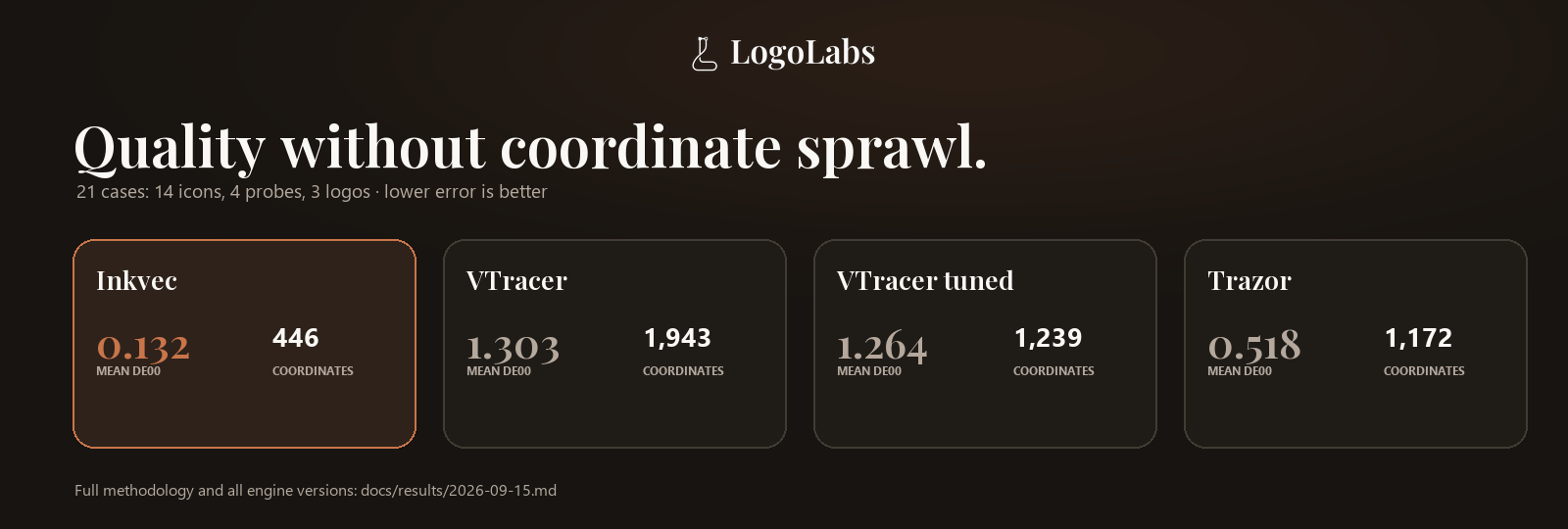
Inkvec vs two other engines (VTracer and Trazor) on 21 cases, scored with CIEDE2000 colour error, DISTS, DINOv3, and coordinate count. The set is fixed from the selection seed crosscompare-2026-09-15-v1 (bench/crosscompare_current.py): 14 hash-selected real icons (2 per family across lucide, material-icons, simple-icons, twemoji, noto-emoji, openmoji and fluent-emoji), 4 hand-picked synthetic probes (prim_circle, mosaic_pie6, gradient_linear, gradient_radial), and 3 real brand logos drawn from an external brand dataset that is not part of this repository — a clean clone selects only the other 18 (see docs/results/2026-09-15.md):
| Engine | Mean dE00 ↓ | Median dE00 ↓ | DISTS ↓ | DINO ↑ | Coords vs Inkvec | Time |
|---|---|---|---|---|---|---|
| Inkvec | 0.132 | 0.054 | 0.0236 | 0.991 | 1× (446) | 1.17 s |
| VTracer (default; 0.6.15 / 1.0.0-alpha.4) | 1.303 | 0.598 | 0.051 | 0.963 | 4.4× (1,943) | 0.04–0.05 s |
| VTracer (tuned, 1.0.0-alpha.4) | 1.264 | 0.579 | 0.064 | 0.954 | 2.8× (1,239) | 0.06 s |
| Trazor | 0.518 | 0.227 | 0.048 | 0.971 | 2.6× (1,172) | 2.19 s |
The two VTracer defaults (0.6.15 and 1.0.0-alpha.4) are the same engine: they emit byte-different files but near-identical geometry (per-case dE00 0.0001–0.0012), and only the tuned setting differs materially — they are not independent corroboration. "Coords vs Inkvec" counts each primitive (<circle>, <ellipse>, <rect>) as 2 coordinates and each cubic as 6, which favours engines that emit primitives. Against the artist's own file, Inkvec's like-for-like ratio (geom_ratio: geometry parameters ÷ ground-truth geometry parameters) is 1.402 on this set. n = 21, with no error bars or significance test; the timings are approximate.
One engine is deliberately absent from the table: color-trace ("potrace-color", migvel/color_trace — pngquant quantisation + per-layer Potrace) is not apples-to-apples, because it reproduces the raster by drawing every pixel back rather than tracing artist-shaped geometry — on these same 21 cases its median dE00 is 0.229 at a median 25,018 coordinates, against Inkvec's 0.054 at 202 — roughly 124× the coordinates. Full detail in the non-apples-to-apples section of docs/results/2026-09-15.md.
VTracer is meaningfully faster — this is a quality/speed trade, not a free win. Source: docs/results/2026-09-15.md.
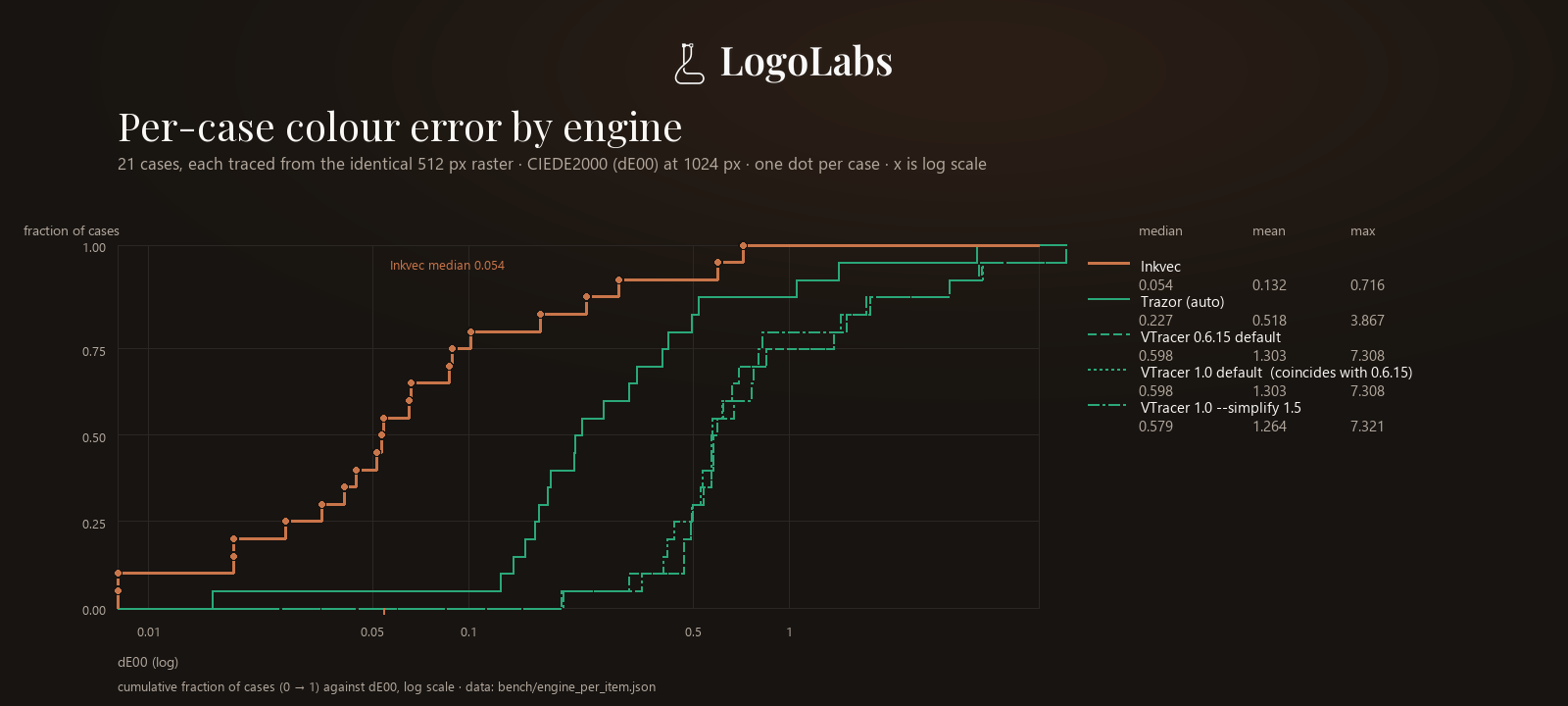
Per-case colour error (dE00) over the 21 cases — the distribution behind the table's mean and median, not only the summary. Reproduce with python tools/make_engine_distribution.py, which reads bench/engine_per_item.json (one row per case × engine).
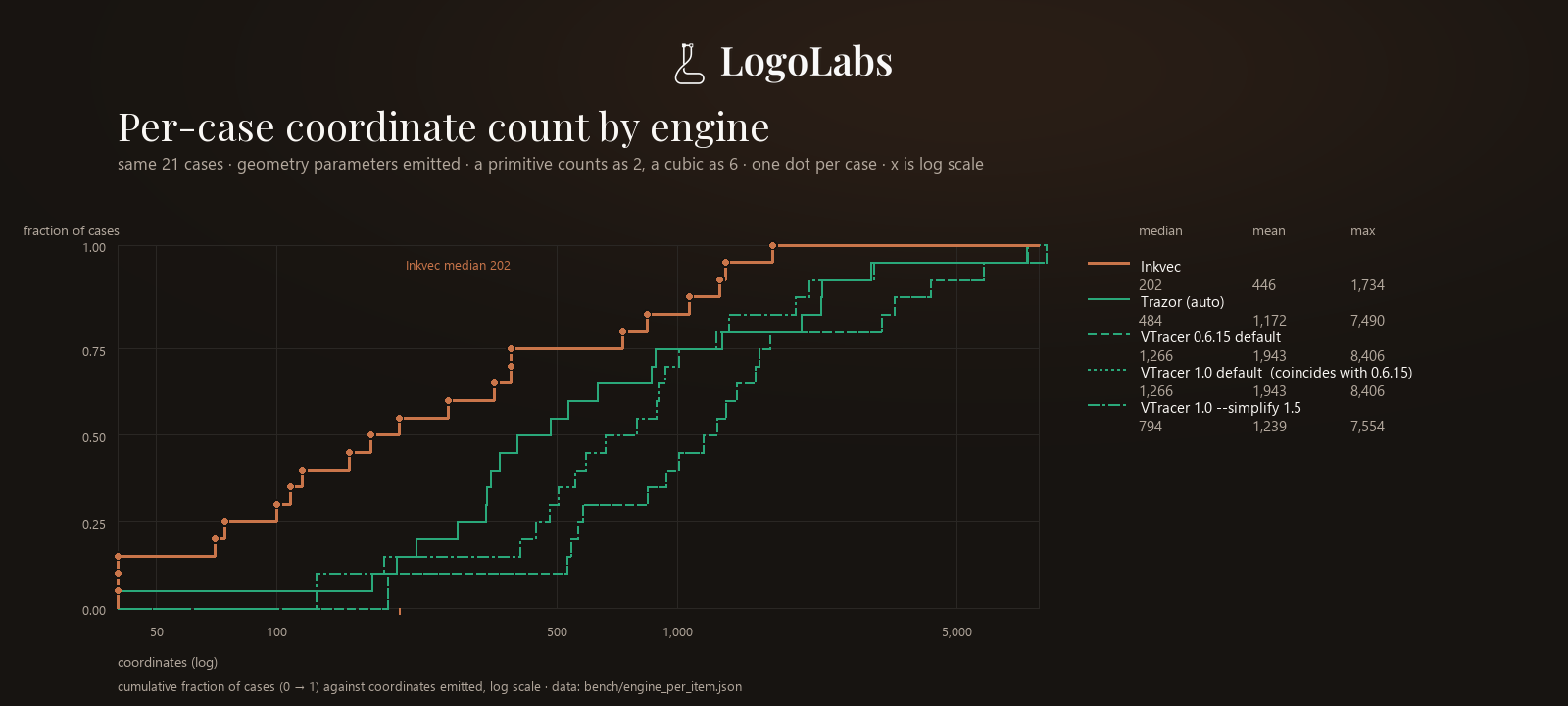
Per-case coordinate count over the same 21 cases, from the same script and data file.
Inkvec's row was re-measured on the 0.1.1 release build (inkvec.exe sha256 73c2f67a4e42194a42f72eba9063815942accb8e05d3e70e472fad1b5d115753), and these two distribution charts are from that same run; the competitor rows are unchanged because their binaries reproduce exactly (VTracer default 1.303 / 1,943; tuned 1.264 / 1,239; Trazor 0.518 / 1,172).
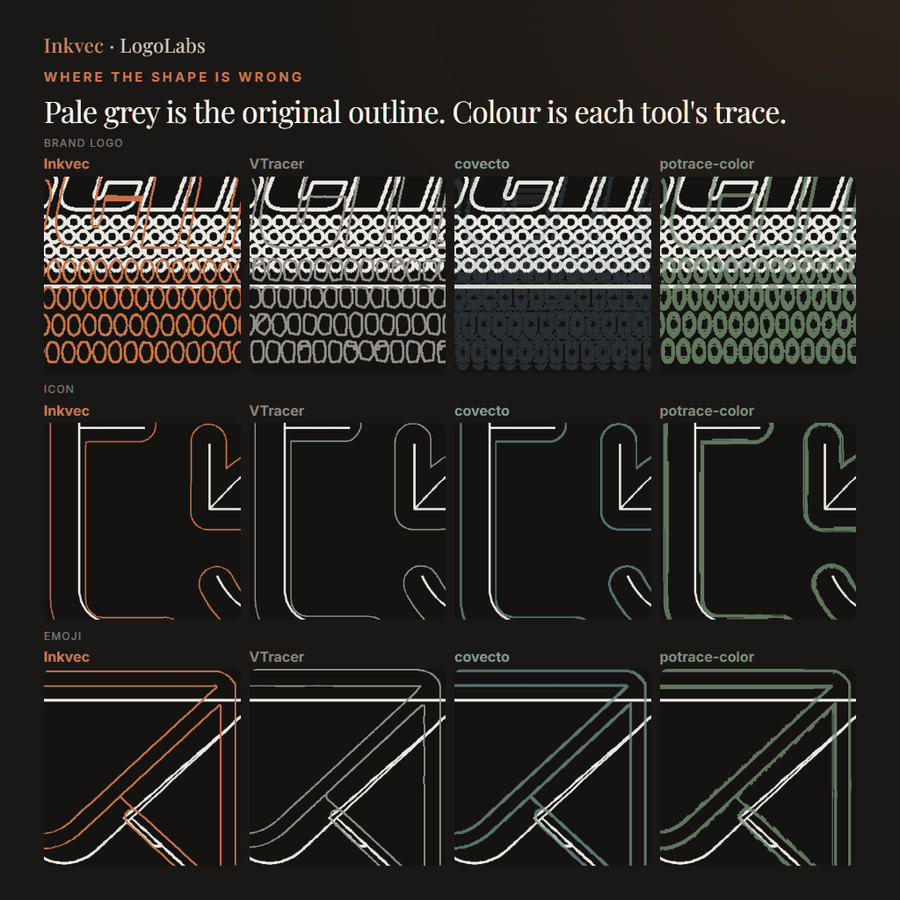
On the regression corpus (246 icons from lucide, material-icons, simple-icons, noto-emoji, openmoji, twemoji — the set CI gates on), with the current defaults: mean dE00 0.148, 1.48× the parameters a human author would use. That mean is a family macro-average, so read it next to the median (per-item) 0.110 — p10 0.023, p90 0.389, worst 0.69 (
noto-emoji/emoji_u1f9d1_1f3fd_200d_1f91d_200d_1f9d1_1f3ff), none of the 246 above dE00 1.0. Releases up to 0.1.3 measured 0.299 on the same set: they composited transparent input onto white before tracing, and their shape harmonization was not held to the traced boundary (see Shape harmonization). Source:bench/gate/baseline.json.
Damaged input: JPEG, WebP, AI-decoder output
Inkvec ships an optional trained restorer that removes compression and decode damage before tracing. It is off by default (--restore off; --restore auto enables it only when the input looks damaged). The weights that ship — restorer.onnx from Logolabs/inkvec-denoiser-001, pulled on first use or via tools/pull_model.py — have no published benchmark in this repository, and no LPIPS or ablation figure for them is reported anywhere here. The figures that previously appeared in this section were measured during development on a different checkpoint and are not reproduced for the shipped weights; the VectorArk and StarVector numbers were those projects' own published results, measured under their protocols, not here.
The same pre-pass runs in the browser, on the same restorer.onnx: see In the browser.
Install
Pre-built binaries
Download the latest release for your platform from the Releases page.
Each release carries three kinds of download, and they do not all run on the same systems. The floor below each one is asserted during the build, from the binary itself, rather than assumed:
| Download | What it is | Oldest system it starts on |
|---|---|---|
inkvec-<version>-<target>.tar.gz / .zip |
The command line | Linux glibc 2.17 (CentOS 7, Debian 8, Ubuntu 14.04 and newer) · macOS 10.12 on Intel, 11.0 on Apple silicon · Windows 10 |
inkvec-<version>-<target>-restore-model.tar.gz / .zip |
The command line with the ONNX-Runtime restorer (--restore) compiled in |
Linux glibc 2.38 and libstdc++ 13 (Ubuntu 23.10, Debian 13, Fedora 39, RHEL 10 and newer) · macOS 11.0, Apple silicon only · Windows 10 |
inkvec-studio-<version>-<target>.deb / .rpm / .AppImage / .dmg / .exe / .msi |
Inkvec Studio, the desktop app | Linux glibc 2.38, libstdc++ 13 and WebKitGTK 4.1 (Ubuntu 23.10, Debian 13, Fedora 39 and newer; built on Ubuntu 24.04) · macOS 10.15 on Intel, 11.0 on Apple silicon · Windows 10 with WebView2 (the installer fetches it) |
The two higher floors are ONNX Runtime's: the restorer links a prebuilt copy of it
statically, and that prebuilt calls glibc 2.38 and GCC 13 symbols. The app ships the
restorer, which is why its Linux packages need a recent distribution. On anything older,
the plain command-line archive is the one to take — it is built against glibc 2.17 and
runs everywhere, without --restore.
Build from source
cargo install --path crates/inkvec-cli
or from a checkout:
cargo build --release -p inkvec-cli
target/release/inkvec logo.png -o logo.svg
Requires Rust 1.88 or newer. cargo test --release --workspace runs 200+ tests.
Quickstart
inkvec logo.png -o logo.svg
  intake        2x more pixels than detail: scaling min-area x4
logo.png (512x512)
  palette       3 colours, 26 faces (0 gradient)
  planar map    29 shared edges (3 primitive)
  boundary solve  E 285.5 -> 23.0 in 7 iteration(s), 7208 point(s) moved
  symmetry      none in the label map
  repair        0 boundary refit(s) to stop rings crossing
  segments      266  (160 line, 106 cubic) from 9176 measured points, 34.5x reduction
  lambda        8.54
  wrote         logo.svg (7886 bytes)
Exit codes: 0 success · 1 usage/input error · 2 flat input under --strict · 3 debug-dump write failure.
Usage
inkvec <input> [-o <output.svg>] [OPTIONS]
| Flag | Default | What it does |
|---|---|---|
--restore <auto\|on\|off> |
off | Trained-network cleanup for JPEG/WebP/AI-decoder damage. auto only restores if it looks damaged, and traces directly when no restorer is available (on is an error then). |
--sr <auto\|on\|off> |
off | Super-resolution pre-pass (2-4× upscale), complementary to --restore. |
--lossy <auto\|on\|off> |
auto | Whether to trust the file as clean or trace with noise-aware intake. |
--max-dim <px> |
2048 | Cap on the longer side; SVG is written at the original size. |
--time-budget <s> |
0 | Advisory wall-clock budget; trace is still correct if it runs out. |
--no-background |
off | Drop the face that paints the whole canvas. |
--minify |
off | No ids, no groups, no trailing zeros — ~10% smaller, identical geometry. |
--no-native-alpha |
off | Composite transparent input onto a matte before tracing, as releases up to 0.1.3 did. |
--no-harmonize |
off | Skip shape harmonization (see below). |
--merge-colors <groups> |
none | Draw several fills as one, so the shapes between them join: '#c0392b,#e74c3c;#2c3e50,#34495e' merges each group into its most-used fill, =#hex or =@n picks the result, > joins gradient stops. Costs one extra trace. |
--margin <f> |
0 | Transparent margin around the output, as a fraction of the larger side; the viewBox grows, the geometry does not move. |
--uncertainty <file> |
off | Also write each boundary's confidence band, k sigma either side (--uncertainty-k, default 2), as an SVG that overlays the trace. |
--editability |
off | Post-fit passes for editing by hand: smooth joins, axis-aligned handles, nodes sharing coordinates, exact mirrors, each held to the fit's tolerance. |
--bezier-cost <f> |
6 | What one Bézier segment costs the fit, in parameters (a line costs 2), 2 to 12. Lower draws more curves and fewer straight segments. |
--corner-angle <deg> |
10 | The turn at a join charged as a full corner, 1 to 60. Higher keeps gentler bends smooth. |
--simplify-faint |
off | Fewer coordinates where the two inks at a boundary are close in colour, since a position error there is barely visible. |
--content-units |
off | Scale the fit tolerances with the raster, so a large image gets a small one's parameter count. Trades fidelity for parsimony. |
--intake-scale |
off | Resample an oversampled input (upscaled, blurred, photographed) to one pixel per unit of detail before tracing. Much faster on such input; costs structure. |
Run inkvec --help for the full list.
Transparency (native)
A transparent PNG is traced as it is, not composited onto white first. Every ink is a colour and an opacity, and the transparent ground is an ink of its own, so holes stay holes, a white mark on a transparent ground traces like any other, a translucent panel keeps its fill-opacity, and a glow, halo or soft fade becomes one gradient of stop-color and stop-opacity. Two inks count as one only if they look the same over white and over mid-grey; for opaque colours that is plain OKLab distance, so an opaque input traces exactly as it did before.
Measured on the 246-icon screen set as the mean absolute pixel error of the rendered SVG against the artist's file, over a dark ground and on the alpha channel: 0.063 and 0.069 for the composite-onto-white path, 0.0017 and 0.0031 now. On the nine corpus icons with real interior translucency (steam, glass, halos) the dark-ground error falls from 0.046 to 0.0077. --no-native-alpha restores the old path.
Shape harmonization (on by default)
After fitting, marks that repeat across the drawing — a run of identical tabs, segmented rings, tiled glyphs — are matched by affine-normalized outline similarity (IoU threshold --harmonize-threshold, default 0.92) and redrawn from one consensus geometry per cluster. The pass exists to save parameters on drawings with genuinely repeated compound shapes.
The clustering compares 48×48 masks, where a line a pixel out of place barely changes the overlap, so on its own it would stamp one shape's geometry over near-misses. Each member is therefore held to its own evidence: it takes the consensus only if that lands within 0.1 px of the boundary it was traced at (solved against colour and, on a transparent ground, against alpha) and costs fewer parameters than its own drawing. A face that another face is drawn against — one punched out of the faces below it (translucent, faded, a clear counter) or one with a translucent face sitting in its hole — is never moved, since moving one side of the pair would open a gap onto the ground; nor is a ring written as a fitted circle or rounded rectangle, which is already exact. Releases up to 0.1.3 had none of these checks, and there harmonization raised mean dE00 on the screen set from 0.151 to 0.299 to save 0.6% of the parameters. Guarded, it changes 2 of the 246 icons, both cheaper and neither worse. --no-harmonize turns it off.
Optional features
| Feature | What it adds | Cost |
|---|---|---|
restore-model |
Trained restorer (--restore) via ONNX Runtime, CPU |
Downloads prebuilt ONNX Runtime at build time |
restore-burn |
Same network via Burn, pure Rust, no native library | ~4× slower than restore-model |
restore-wgpu |
Restorer via Burn on GPU (Vulkan/DX12/Metal) | No CUDA needed |
cargo build --release -p inkvec-cli --features restore-model
The denoiser weights (restorer.onnx) are hosted on Hugging Face at Logolabs/inkvec-denoiser-001 under Apache-2.0, and are automatically pulled on first --restore use. To pull manually:
python tools/pull_model.py
Inkvec Studio Lite
The desktop app (Windows, macOS, Linux; installers on the Releases page) runs this engine on your own computer — an image is never uploaded. Its tabs:
- Vectorize: the trace beside the source under one pan and zoom, with wireframe, anchor,
handle and Certainty overlays (the engine's
--uncertaintybands: where each boundary could be, coloured by how sure the pixels are), a quality report that is a measurement rather than a badge, and every control above. Each image opened is traced automatically; Custom walks through what the image is, clean-up, colours, detail and shape, side by side with the automatic trace. The palette shows flat and gradient inks and colour groups: drag one ink onto another and the re-trace draws them as one fill (--merge-colors), with merges proposed from each trace and never applied unasked. An SVG can be opened too, and is rebuilt by re-tracing it. - Minify SVG:
inkvec-svgminon a file you already have. - Fabricate: prepare an SVG for a cutter, in millimetres (
crates/inkvec-fab) — one colour, layered vinyl with bleed and registration marks, inlay, print-then-cut sticker, stencil with bridges, or Lines for a pen, scoring blade or laser line. Kerf, mirror for heat-transfer vinyl, weed border, a size-check square; a preflight that draws the parts too thin to cut before you cut them; SVG per sheet, DXF R12 with true arcs, GRBL G-code with G2/G3 arcs, and dogbones for a router bit. - Batch: a folder and a preset, one SVG per file.
How it is built and the decisions behind it: studio/README.md.
In the browser
crates/inkvec-wasm compiles the same pipeline to WebAssembly (the npm package's engine). The Hugging Face Space opens on a presentation page (web/index.html: before and after on real logos with the geometry showing, the latest comparison with other tracers, what is new) that leads into Inkvec Studio Lite.
Inkvec Studio Lite is the whole Studio interface in the browser: the desktop app's own frontend and its shared Rust core (studio/core) compiled to WebAssembly and run in a Web Worker (studio/wasm) — Vectorize with drafts and the wizard, the palette and colour groups, export as downloads, Minify and Fabricate, with Full screen. cd studio && npm run build:web builds the Space (the presentation page at the root, the Studio under studio/); see studio/README.md.
Try it live: huggingface.co/spaces/logolabs/inkvec
The denoiser in the browser
--restore's trained denoiser runs there too, off by default and with the same three modes (off, auto, on). It is not a port: the page loads the same restorer.onnx from Logolabs/inkvec-denoiser-001 — verified against the same SHA-256 the CLI checks — into ONNX Runtime Web, which runs it on WebGPU where the browser has it and on WebAssembly kernels where it does not.
Nothing around the network is reimplemented in JavaScript either. The compositing onto white, the pad to a multiple of 16, the crop, the quantisation to 256 levels and the extreme-snapping are inkvec-restore's own (network_input / network_output), reached through the WebAssembly build; --restore's auto decision is inkvec_restore::decide, the same interior-residual test; and the trace that follows is forced onto soft intake exactly as the command line forces it. The pipeline is split at the seam the command line has — inkvec_cli::intake, the restorer, inkvec_cli::trace_prepared — because ONNX Runtime Web's session is asynchronous where the tracer is not, so the network cannot be called from inside the pipeline the way an in-process backend is.
Measured against native ONNX Runtime on a 512-px JPEG, ONNX Runtime Web's WebAssembly kernels agree with the native ones to 4.2e-7; after the 8-bit quantisation the tracer reads, one channel of one pixel in 786,432 differs by one level.
The runtime (~28 MB) and the weights (~80 MB) are fetched on first use and cached by the browser. The image is not: it never leaves the machine, denoiser or no denoiser.
To use it from JavaScript or TypeScript — browsers, Node.js, Deno, Bun — use the npm package @logolabs/inkvec (packages/npm): await trace(bytes, { colors: 16 }), with typed options, a threaded build at @logolabs/inkvec/threads, and the same output on every runtime.
Minifying an existing SVG
The same objective works on vector input. inkvec-svgmin rewrites an SVG's paths as the
fewest segments that draw the same picture — a circle drawn as sixteen cubics becomes arcs,
a curve split into four pieces becomes one — while corners in the source survive exactly
and nothing but d attributes changes:
inkvec-svgmin logo.svg -o logo.min.svg --stats
The tolerance is stated at a viewing size (--tolerance 0.1 --judge 1024: nothing moves
more than a tenth of a pixel at 1024 px). On 40 corpus artist files it removes 23.9% of the
numbers and 23.5% of the bytes at a mean dE00 of 0.0077 against the original — ahead of
SVGO's defaults on bytes, and complementary to them. On the tracer's own output the
geometry gives up 5.8%, which is the check that the emitter is already description-length
minimal, and the bytes give up 22.1%. See
crates/inkvec-svgmin.
Library API
use inkvec_cli::{trace_image, post_process, Args};
use inkvec_trace::load_image;

fn trace(input: &str) -> Result<String, Box<dyn std::error::Error>> {
    let args = Args { input: input.into(), ..Args::default() };
    let img = load_image(&args.input)?;
    let traced = trace_image(img, &args)?;
    Ok(post_process(&args, traced.svg, traced.width, traced.height))
}
Args::default() holds every flag's default. trace_image is the whole pipeline behind both the CLI and the WASM build; inkvec_cli::intake and trace_prepared are its two halves, for a caller that needs to reach between them — that is where the restorer runs, and it is how the browser runs the denoiser in a runtime this crate cannot call into. Pixels that came back from such a restorer are traced with inkvec::trace_rgba_restored, which forces the soft intake --restore forces.
Language bindings
The inkvec crate (crates/inkvec) is the stable library API, and every other language reaches the same pipeline through it:
| Language | Package (source) | Call |
|---|---|---|
| Rust | inkvec (crates/inkvec) |
inkvec::trace(&png, &inkvec::Options::default()) |
| C / C++ | inkvec_ffi + inkvec.h (crates/inkvec-ffi) |
inkvec_trace(bytes, len, "{\"colors\":16}", &result) |
| Python | inkvec (crates/inkvec-py) |
inkvec.trace("logo.png", colors=16) |
| JavaScript / TypeScript | @logolabs/inkvec (packages/npm) |
await trace(bytes, { colors: 16 }) |
| Java 8+ | com.logolabs:inkvec (packages/java) |
Inkvec.trace(png, InkvecOptions.builder().colors(16).build()) |
| C# / .NET | LogoLabs.Inkvec (packages/dotnet) |
Inkvec.TraceFile("logo.png", new InkvecOptions { Colors = 16 }) |
| Go | github.com/logolabs/inkvec-go (packages/go) |
inkvec.Trace(ctx, png, &inkvec.Options{Colors: inkvec.Ptr(16)}) |
| Swift | Inkvec via github.com/logolabs/inkvec-swift (packages/swift) |
try Inkvec.trace(png, options: InkvecOptions(colors: 16)) |
| PHP 8.1+ | logolabs/inkvec (packages/php) |
Inkvec::traceFile('logo.png', new Options(colors: 16)) |
| HTTP (Docker) | ghcr.io/logolabs/inkvec (crates/inkvec-server) |
curl --data-binary @logo.png -H 'Content-Type: image/png' 'localhost:8080/trace?colors=16' |
Every binding takes the same options, generated from one schema, and reproduces the same contract fixtures; they share the command line's defaults, native transparency and guarded shape harmonization included. None is published to its registry yet — build from this repository. See docs/BINDINGS.md.
How it works
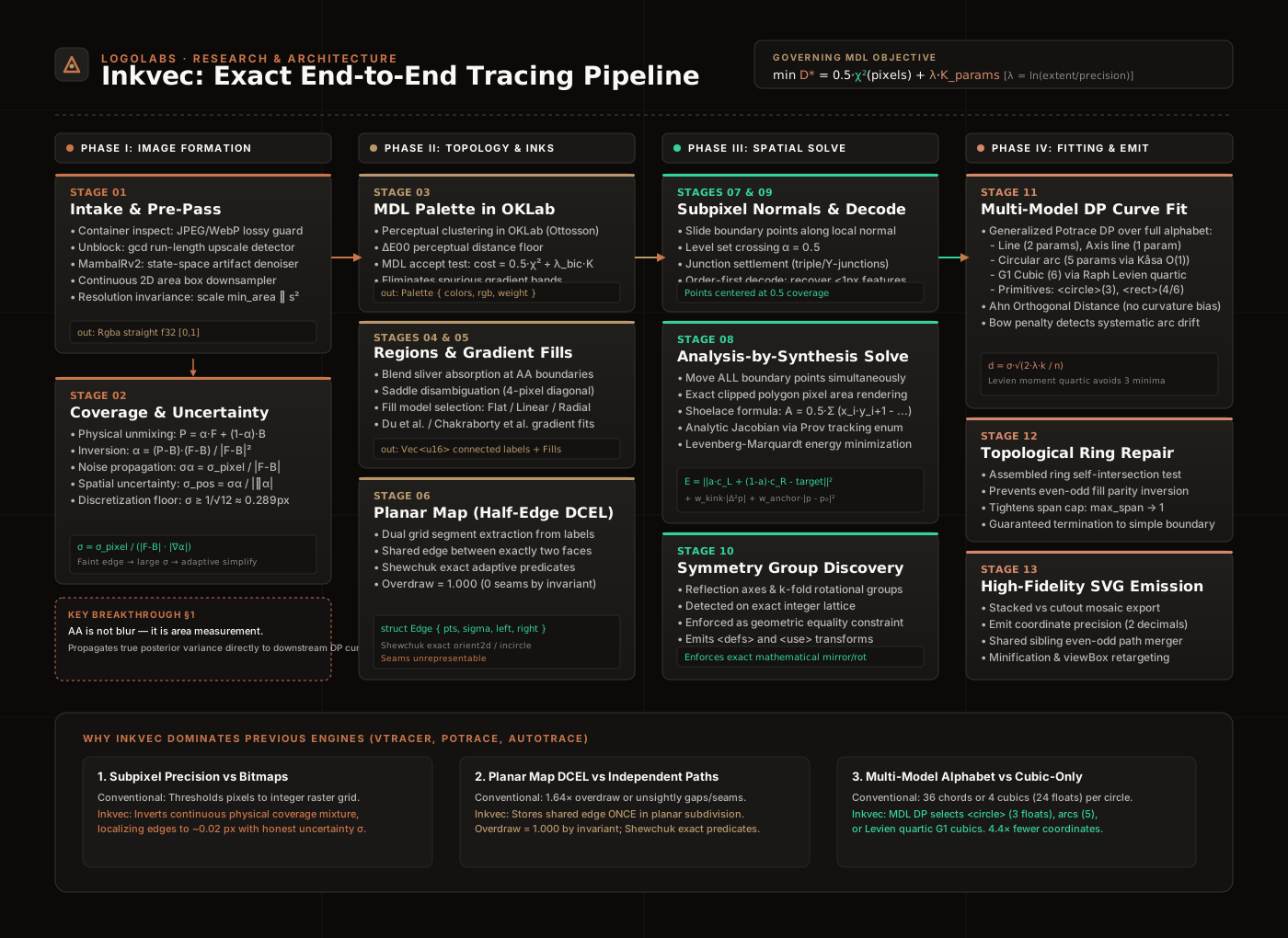
Each stage is documented in depth in the pipeline series — what problem it solves, what it hands forward, and where every constant comes from.
- Intake & Super-Resolution. Lossy container inspection, GCD upscale unblocking, MambaIRv2 state-space restoration, and exact continuous area-weighted downsampling.
- Sub-Pixel Coverage. Linear unmixing across 3D RGB channels inverts anti-aliasing to a fraction of a pixel, establishing honest per-point uncertainty $\sigma_{\text{pos}}$.
- Palette. Minimum description length clustering in OKLab ($\Delta E_{00}$) eliminates spurious bands and fake inks.
- Planar Map (DCEL). Boundaries are stored once between adjacent faces, so the model has no overdraw ($1.000\times$ internally); seams are unrepresentable.
- Boundary Solve. Analysis-by-synthesis moves all boundary points simultaneously under nonlinear conjugate gradient (Fletcher–Reeves) with a backtracking line search and an analytic Shoelace-derived gradient.
- Curve Fitting. Global dynamic programming over lines, arcs, Raph Levien quartic G1 Béziers, and primitives (
<circle>,<ellipse>,<rect>). - Repair & Emit. Capped span refitting eliminates self-crossing rings; output is emitted with shared geometry and clean even-odd paths.
📖 Comprehensive Technical & Scientific Guide: See PIPELINE_EXPLANATION.md for full mathematical derivations, branded step-by-step diagrams, and an extensive review of all research and arXiv papers used (AnchorFlow, VectorArk, AdaVec, SuperSVG, MambaIR, Levien Bézier fits, Shewchuk exact predicates, and more).
🤖 AI Provenance & Transparency: See docs/AI_USAGE.md for our detailed disclosure separating agentic development tooling, runtime restoration models (EuroHPC Arrhenius-trained denoiser & MambaIR), and the 100% deterministic non-neural mathematical geometry core.
Full stage reference: docs/algorithm/ (start at docs/algorithm/index.html). Design rationale: docs/DESIGN.md.
Benchmark and CI gate
bench/ scores against a source SVG with CIEDE2000, DISTS, LPIPS, DINOv2/v3, parameter ratio, bytes and time. CI runs cargo test on Linux, Windows and macOS, then bench/ci_gate.py against the 246-icon screen set, failing if colour error or anchor turning rise more than 1% or the parameter ratio more than 5%.
Known Limitations & Technical Boundaries
See docs/LIMITATIONS.md for our comprehensive architectural boundary disclosure.
Inkvec is engineered specifically for graphic artwork, logotypes, icons, and diagrams. Because the core operates under an exact planar partition and description-length model, specific inputs are outside its design scope:
| Scenario | Expected Behavior / Failure Mode | Recommended Alternative |
|---|---|---|
| Photographs | Natural color transitions violate discrete ink models; causes severe color banding and high coordinate counts. | Keep as AVIF/WebP raster or use diffusion curves. |
| Text & Typography | Glyphs are traced purely as geometric Bézier contours (<path>); no font detection, OCR, or <text> tags. |
Use an OCR engine (e.g. Tesseract) for semantic text. |
| Variable-Width Art / Sketches | Medial axis stroke recovery (--strokes) requires uniform width; rough sketches fall back to filled outlines. |
Use manual vector pen tools or specialized sketch tracers. |
| Sub-Pixel Gaps (< 1px) | Optical anti-aliasing ramps overlap, merging fine gaps into single faces. | Enable --sr on (MambaIR) to upsample before tracing. |
| Exotic Gradients & Blurs | Linear and radial gradients are supported; mesh gradients, angular sweeps, and drop shadows are quantised into bands. | SVG 1.1 limitation; manual gradient mesh authoring. |
| Real-Time / 60 FPS Video | Heavy global optimization (nonlinear conjugate gradient + MDL DP) takes $\approx 1.2\text{s}$ per graphic. | Use Potrace (<0.01s) or VTracer (~0.04s) for interactive speed. |
Roadmap & Future Work
Active engineering initiatives tracked in docs/TODO.md:
- Neural Post-Processing Refinement Pass: Integrating our 20M vision-conditioned Graph Neural Network (TraceRefineGNN20M) with equality-constrained CAD least-squares snapping (KKT solver) and topological collinear edge collapse to eliminate subtle raster quantization and restore sharp $C^0$ corners.
- High-Volume Benchmarking: Scaling from the 246-icon regression gate to a multi-thousand-sample suite across diverse complexity tiers, streaming multi-engine Pareto frontiers against Potrace, VTracer, and Adobe Illustrator.
Licence
Apache-2.0. See LICENSE. Third-party components: docs/THIRD_PARTY.md. Every Rust dependency of the default build is permissive; two weakly-copyleft MPL-2.0 crates (colored, option-ext) are pulled in only by the optional Burn restorer backends (restore-burn/restore-wgpu/cuda), never by default features or the published default/restore-model archives. Potrace (GPL) is used only as a benchmark baseline — never linked or redistributed.
Trademarks
Trademarks, logos, brand and company names shown in this repository, in its benchmark corpora
and results, in Inkvec Studio's Showcase and on the Inkvec Space are the property of their
owners. They appear only to compare how vectorisation engines trace real artwork; this implies
no affiliation with, sponsorship by or endorsement from their owners. An owner who objects to a
mark being shown can open an issue or write to
office@incorpo.ro, and it will be removed. See docs/TRADEMARKS.md.
Citation
@software{inkvec2026,
  title  = {Inkvec: exact raster-to-vector tracing by minimum description length},
  author = {{LogoLabs} and Deleanu, Stefan-Lucian},
  year   = {2026},
  url    = {https://github.com/logolabs/inkvec}
}
Acknowledgements

We acknowledge EuroHPC JU for awarding the project ID EHPC-AIF-2026PG01-907 access to resources on Arrhenius GPU at NAISS, Sweden. The Arrhenius system is operated by the National Academic Infrastructure for Supercomputing in Sweden (NAISS). Compute time on Arrhenius enabled the training and evaluation of the denoiser/restorer model shipped with this release.
About
Inkvec is open source under Apache-2.0, released as part of LogoLabs’ work on logo generation using AI. The studio’s home is logolabs.org.